

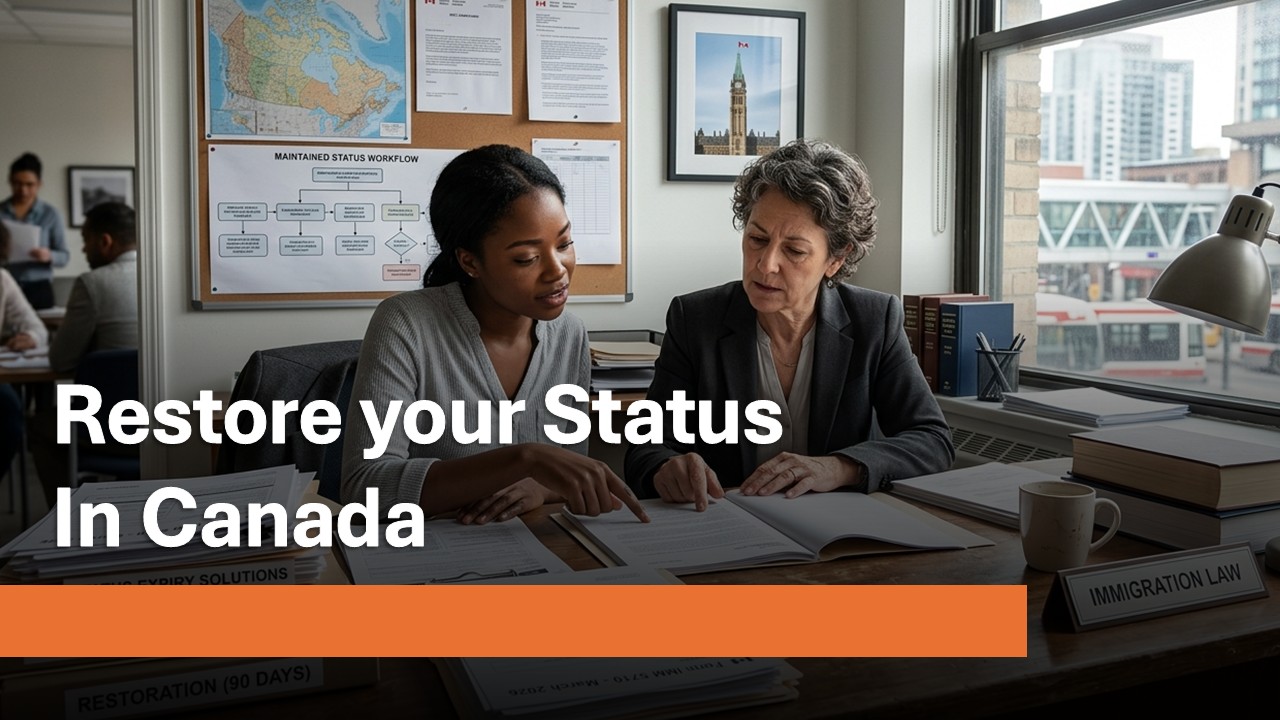
If you are currently living in Canada and noticed that the expiry date on your study permit, work permit, or visitor record is fast approaching, you are not alone.
With Canada’s new 2026-2028 Immigration Levels Plan focusing on reducing the temporary resident population to 5% by 2027, the rules for staying have become much more technical. The automatic extensions of the past are gone. Today, your ability to stay in Canada depends entirely on timing and choosing the correct legal pathway before your current status hits 11:59 PM UTC on its expiry date.
I. The Golden Rule: The 30-Day Safety Zone
The official recommendation from Immigration, Refugees and Citizenship Canada (IRCC) remains unchanged in 2026: Apply to extend your status at least 30 days before it expires.
Why 30 days?
-
Technical Safety: If your application is returned for a missing signature or an incorrect fee, you still have time to resubmit before your actual expiry date.
-
Maintained Status: Applying before expiry grants you maintained status (formerly known as Implied Status), which is the most powerful legal tool for any temporary resident.
II. Option 1: Maintained Status (The Most Important Strategy)
If you submit a complete application to extend your stay before your current permit expires, you automatically have Maintained Status until IRCC makes a decision.
1. How it Works for Workers
If you apply to extend your Work Permit (e.g., transitioning from a PGWP to an LMIA-based permit) before it expires:
-
You can legally continue working under the same conditions (same employer, same location) until a decision is made.
-
Work permit extensions are taking an average of 259 days. This means you could potentially work for over 8 months legally while waiting for your new permit.
2. How it Works for Students
If you apply to extend your Study Permit before it expires:
-
You can continue studying at your Designated Learning Institution (DLI).
-
You can only continue working off-campus (up to 24 hours per week) if your original study permit allowed it and you have already started your new study program.
3. Do Not Leave Canada
Maintained Status is valid only as long as you remain in Canada. If you leave the country, your right to work or study under that status disappears instantly. You may be allowed to re-enter as a visitor, but you cannot resume your job or classes until your new permit is physically approved.
III. Option 2: Transitioning to a Visitor Record
If your work or study permit is expiring and you do not have a path to a new one immediately, you should apply for a Visitor Record.
Why Choose a Visitor Record in 2026?
-
It keeps you in Canada legally for usually 6 months.
-
It buys you time to wait for a Category-Based Express Entry Draw (like the French, STEM, or Trades draws) without having to leave the country.
Requirement: You must apply at least 30 days before your current permit expires. You must stop working/studying the moment your old permit expires.
IV. Option 3: The 2026 Domestic Transition Pathways
In the 2026-2028 Immigration Levels Plan released on March 13, 2026, IRCC announced a one-time initiative to transition 33,000 temporary workers directly to Permanent Residency.
Who Qualifies?
This initiative is specifically for people already in Canada who:
-
Have already submitted their PR application.
-
Are currently working in in-demand sectors (Health, Trades, STEM, Agriculture, Transport).
-
Have a valid work permit at the time of application.
If your status is about to expire, getting an application into this “Domestic Transition” stream can often qualify you for a Bridging Open Work Permit (BOWP), allowing you to stay and work while your PR is processed.
V. Option 4: Employer-Specific (LMIA) Work Permits
If you are a worker and your PGWP or Open Work Permit is expiring, you can go for an LMIA (Labour Market Impact Assessment).
In 2026, many sectors facing critical shortages have Fast-Track LMIA processing. If your employer can prove they cannot find a Canadian citizen or PR to do the job, they can support your application for a closed work permit. This gives you a clear path to stay.
VI. Option 5: The 90-Day Restoration of Status (Emergency Only)
If you wake up and realize your permit expired yesterday, you are officially out of status. You must stop working and studying immediately. However, you have one final safety net.
The 2026 Restoration Rules
Under IRPR section 182, you have 90 days from the date your status expired to apply for restoration of status.
-
You must pay the restoration fee ($229) plus the permit fee.
-
You must provide a Letter of Explanation detailing why you missed your deadline.
-
There is no maintained status during restoration. You must stay in Canada and wait (often 4–6 months) without working or studying. If the restoration is refused, you must leave Canada immediately.
Expert Advice: Stay Informed
The immigration landscape in March 2026 is moving faster than ever. With the government’s goal to reduce temporary residents, documentation and timing are your only defenses.
Always check the Official IRCC Website for the latest “Public Policies” before you file. Sometimes, the government releases emergency extensions for specific groups (like certain nationalities or sectors) that could save your status.
Frequently Asked Questions:
Q: My PGWP is expiring in 2 weeks. Can I extend it?
A: No. A PGWP is a once-in-a-lifetime permit. You must either apply for a different work permit (like an LMIA), a study permit, or a visitor record before it expires.
Q: Can I apply for a new Study Permit from inside Canada?
A: Yes, but as of January 1, 2026, most students applying for a new study permit from within Canada require a Provincial Attestation Letter (PAL) unless they are moving to a Master’s or Doctoral program.
Q: I have an Express Entry profile. Does that give me status?
A: No. Simply having a profile in the pool does not give you the right to stay in Canada. You only get status (via a BOWP) after you receive an ITA and submit your final PR application.
Q: What happens if I stay past my 90-day restoration window?
A: You are at risk of a removal order from the CBSA. Overstaying past the 90-day window makes it extremely difficult to ever return to Canada or apply for PR in the future.